
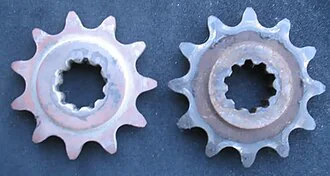
Fitting a new chain to worn sprockets destroys the chain in a fraction of its expected life. It is the most common and most expensive mistake in this product category, and it is why chain and sprockets are sold as a set.
Reading the size code
A code like 428 or 520 encodes two dimensions:
- First digit — pitch, in eighths of an inch. A "4" means 4/8 inch (12.7 mm) between pin centres; a "5" means 5/8 inch (15.875 mm).
- Second and third digits — width between the inner plates, on a scale specific to the standard.
So 428 and 520 have different pitch and different width and are not interchangeable in any circumstance. Within a family, 520, 525 and 530 share the same pitch but get progressively wider and stronger — a 525 chain will not fit a sprocket cut for 520.
The other number is link count, which depends on the wheelbase, the swingarm and the sprocket sizes, not on the model alone. A chain supplied too short is scrap; supplied long it is shortened at fitting, so quoting a link count at or slightly above requirement is the safer default.
O-ring, X-ring and plain
Standard chains have no seals: the grease packed into the pin and bush at manufacture washes out within a few hundred kilometres, after which the joint runs on whatever lubricant the rider applies.
Sealed chains place elastomer rings between the plates to retain factory grease inside the pin and bush.
- O-ring — round section. Effective and inexpensive. The ring is compressed flat in service, which creates measurable drag.
- X-ring — X-shaped section with four contact lips. Seals better and produces less drag because the contact area is smaller. More expensive.
In dusty markets — unpaved roads, dry season, agricultural use — the sealed chain's advantage is much larger than in a temperate urban market, because the failure mechanism there is abrasive ingress rather than lubricant loss. For those markets a sealed chain is worth recommending even where the buyer is price-driven, and the reason is easy to explain.
Plain chains remain appropriate for small-displacement machines where the sprocket and chain package is light and the replacement cost is low.
Tensile strength and what it does not tell you
Chains are quoted with a tensile strength in kN. It is a useful comparison figure between chains of the same size, but it describes the load at which the chain breaks in a single pull, which is not how chains fail in service.
Chains fail by wear: the pins and bushes wear, each joint gains a fraction of a millimetre of play, and across a hundred-odd links that adds up to visible slack. The chain has not stretched — the metal has worn away. This is why "chain stretch" is measured, not weighed.
Measuring wear
Pull the chain taut and measure across a defined number of links, comparing against the nominal length for that pitch. When measured length exceeds nominal by roughly 2–3%, the chain has reached the end of its useful life. Beyond that the pitch no longer matches the sprocket teeth, load concentrates on a few teeth, and sprocket wear accelerates sharply.
A second check: pull the chain away from the rear sprocket at the three o'clock position. If it lifts far enough to expose most of a tooth, the chain is finished regardless of what the measurement says.
Sprocket wear, and why the set matters
A worn sprocket has teeth with a hooked, asymmetric profile — the drive face wears into a curve. That hooked profile no longer matches the pitch of a new chain, so the new chain is loaded unevenly from the first kilometre and wears at several times its normal rate.
The economics are straightforward and worth putting in front of a customer who wants to save on sprockets: a chain fitted to worn sprockets typically lasts a small fraction of its rated life, so the saving on two sprockets is lost on the chain and then lost again on labour.
Tooth count changes
Customers frequently ask about changing sprocket sizes to alter gearing. The rules are simple and worth being able to state:
- Smaller front or larger rear — more acceleration, lower top speed, higher engine revs at cruise.
- Larger front or smaller rear — the opposite.
- One tooth at the front is roughly equivalent to three at the rear, so front changes are coarse adjustments.
Two practical constraints: changing tooth counts changes the required chain length, and a much smaller front sprocket forces a tighter wrap angle that accelerates chain wear. Changes beyond a tooth or two in either direction should be treated as a different specification rather than a variant.