
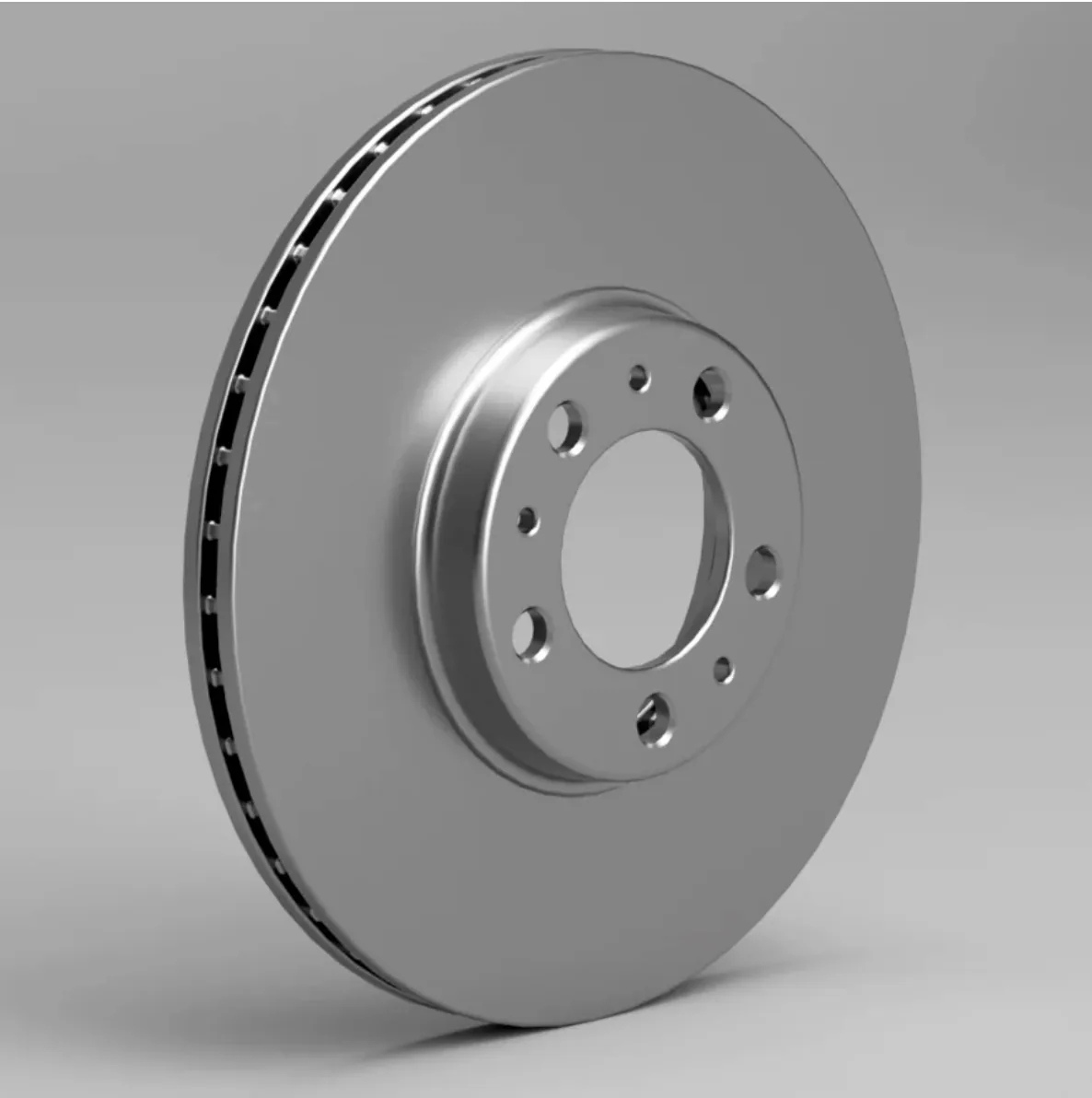
Auto parts break packaging in three distinct ways: they are dense for their size, they have machined surfaces that corrode, and many have sharp edges that cut through whatever is around them. A carton specification that handles one of those will fail on the others.
Weight is the first constraint
A carton of brake discs weighs far more per unit volume than almost anything else in general trade. Two consequences:
Carton grade has to match the weight, not the size. A small box holding 20 kg of discs needs double-wall board with a compression rating suited to the stack height. Single-wall board sized by dimension will collapse in the middle of a pallet.
Bottom cartons carry everything above them. Stack height has to be limited by the compression rating, and that rating falls substantially at high humidity — figures around 50% loss are commonly cited for tropical conditions. A stack that is stable in a dry warehouse can crush in a container crossing the equator.
The practical rule: specify carton compression against the destination's humidity and the actual stack height, not against a bench figure.
Machined surfaces
Anything with a machined face — discs, drums, hubs, flanges, shafts — will corrode in transit unless protected. Options in ascending cost:
- Rust-preventive oil, cheapest, requires degreasing at fitting.
- VCI paper or film, inexpensive and effective in a reasonably closed package.
- Individual poly bags with VCI, better for parts that will sit in distributor stock.
- Coated parts, highest cost, best shelf appearance.
The mistake worth avoiding is protecting the part and ignoring the package. VCI works by saturating an enclosed volume; a treated part in an open carton loses most of the benefit.
Sharp edges and hard parts
Stamped brackets, chain sets, sprockets and suspension components have edges that cut through bags, abrade neighbouring parts and eventually work through the carton itself. Two habits solve most of it:
Individual wrapping so parts do not contact each other. Parts packed loose in a carton arrive scratched even when the carton is intact.
Void fill. A part that can move will move, for six weeks. Movement is what turns a sharp edge into a hole in the carton.
Palletisation
For dense goods, palletising is usually worth it despite the volume cost:
- Handling damage falls sharply — a pallet is moved by machine rather than by hand.
- Loading and unloading are much faster, which matters when demurrage is charged.
- Stack integrity is controlled by the pallet pattern rather than by whoever loaded the container.
Two checks: confirm the destination can handle pallets — sending pallets to a warehouse with no forklift creates a problem rather than solving one — and confirm wood packaging carries the required treatment mark, since untreated wood is refused at many borders and the mark must be on the wood itself.
Labelling a mixed shipment
Auto parts shipments are usually many SKUs in modest quantities, which makes sorting at destination the real work. What makes that fast:
- Part number prominent on at least two faces, in a size readable from a distance.
- Quantity per carton stated, so a count can be done without opening.
- Carton numbering in the form 12/47, which immediately reveals a missing box.
- A scannable barcode where the distributor's system uses one — printed large enough and not across a corrugation, or it will not read.
- Gross weight, for handling equipment selection.
Where several part numbers share a carton, an itemised packing list attached to the outside saves the receiving warehouse considerable time and prevents the miscounts that turn into disputes.
What to check before the first shipment
- One packed carton, weighed and measured, with the marks as they will actually be printed.
- A compression figure for the carton grade at the planned stack height.
- Confirmation that machined surfaces are protected and that the protection is inside a closed package.
- Wood packaging treatment mark, if palletised.
- A barcode test scan on the printed carton, not on a proof.
All five are cheap at the sample stage and expensive after a container has shipped.