
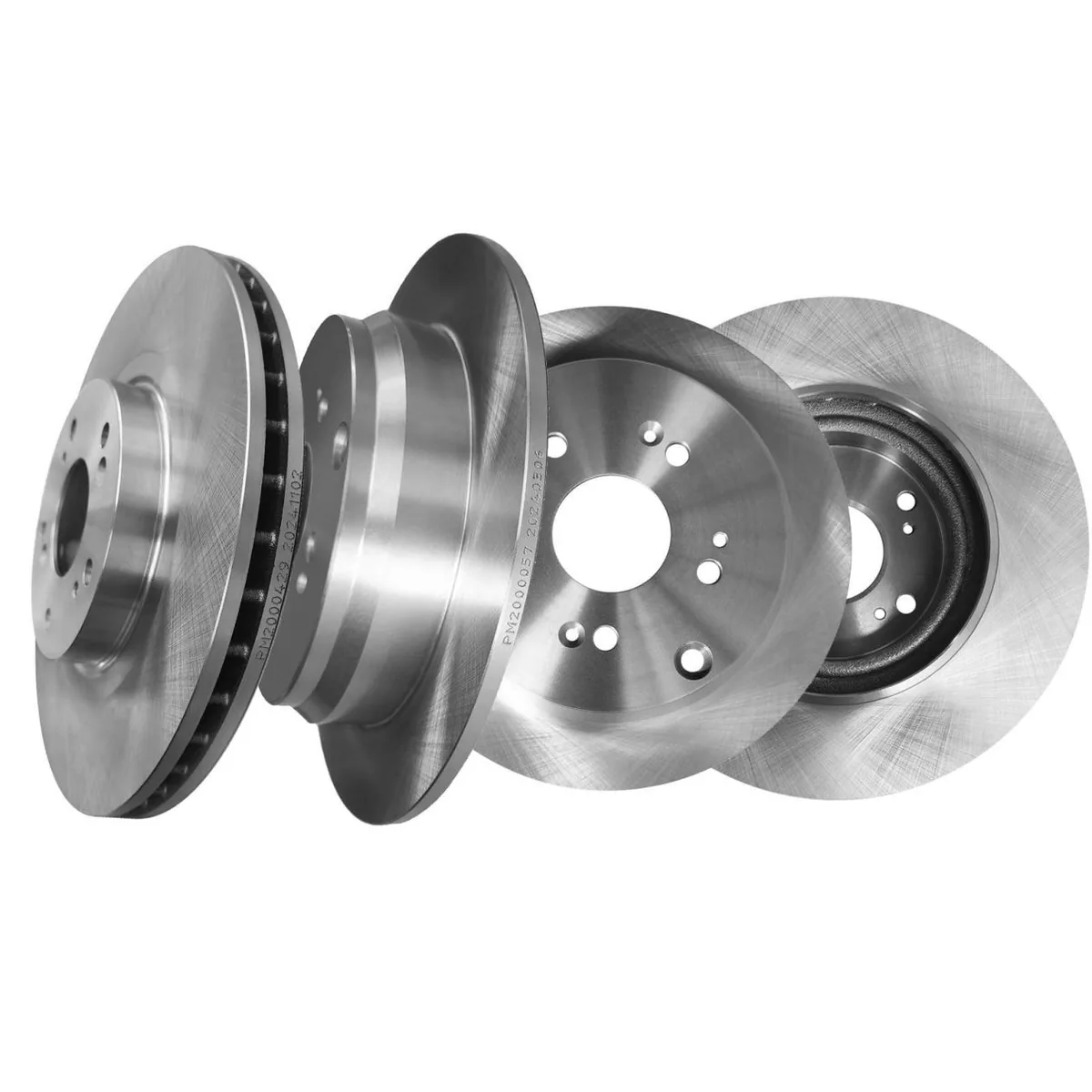
Discs replaced drums on front axles decades ago and stopped there. Drums remain on rear axles of small cars and on light commercials for reasons that have nothing to do with nostalgia.
The self-servo effect
The mechanism that keeps drums alive. In a drum brake, the rotating drum drags the leading shoe further into contact with itself, amplifying the applied force. The brake partly actuates itself.
The practical consequence: a drum brake needs far less hydraulic pressure than a disc of equivalent capacity. On a rear axle where braking effort is modest, that means a smaller master cylinder, less servo assistance, and a cheaper system overall.
It also has a downside that explains why drums lost the front axle: the amplification is sensitive to the friction coefficient, which changes with temperature. As drums heat, the self-servo effect weakens and pedal effort rises noticeably. Discs behave far more linearly.
Where drums still make sense
- Rear axles of light passenger cars. Rear braking effort is a fraction of the front, heat is rarely an issue, and the cost saving is real.
- Parking brakes. A drum holds a static load naturally. Integrating a parking brake into a rear disc requires either a separate drum-in-hat arrangement or a screw mechanism in the caliper — both more complex.
- Dusty and muddy environments. The drum encloses the friction surfaces. In agricultural and unpaved-road use this is a genuine durability advantage, and it is why light commercials in many export markets still specify drums.
- Long service life at low duty. Drum shoes have far more friction material than a pad and last much longer in light use.
The adjustment failure behind most complaints
Drum brakes require a running clearance between shoe and drum, and that clearance grows as the lining wears. Every drum brake has an automatic adjuster to compensate — a ratchet mechanism that takes up slack, usually operating when the parking brake is applied or when reversing.
Adjusters seize. When they do, clearance grows unchecked, and the symptoms arrive in a predictable sequence: a long pedal travel, a parking brake that pulls to the end of its travel without holding, and eventually rear brakes contributing almost nothing.
Customers report this as "the new shoes do not work". The shoes are fine. Two practical responses for a supplier:
- Supply the adjuster and spring kit with the shoes. The hardware is inexpensive, and shoes fitted with old seized hardware fail immediately.
- State in the fitting note that the adjuster must be freed and the brake manually adjusted after fitting. This one line prevents a measurable share of complaints.
Wear limits
Two figures matter and both are usually cast into the drum:
Maximum inside diameter. Drums wear outward and can be machined oversize to restore a true surface. Beyond the stated maximum the wall is too thin to handle heat and can distort or crack.
Minimum lining thickness on the shoe, above the rivet heads or the bonding line. Riveted shoes worn to the rivets score the drum badly and turn a shoe replacement into a shoe and drum replacement.
Where a market machines drums routinely rather than replacing them, stocking oversize shoes matters — standard shoes in a machined drum leave excessive clearance that the adjuster may not be able to take up.
Bonded and riveted
Both remain in production. Riveted shoes allow relining and are common where labour is cheap and parts are expensive. Bonded shoes use the full lining thickness with no rivet heads to score the drum, and are the more common export specification.
For bonded shoes the bond line is the critical quality point, exactly as it is for disc pads. Lining separating from the shoe is the most dangerous failure in this category, and the inspection is the same: check the bond line for gaps on incoming samples.
What to stock alongside
A drum brake job needs more small hardware than a disc job: return springs, hold-down pins and clips, the adjuster assembly, and often a wheel cylinder. Springs lose tension with heat cycling and reusing old ones causes shoes to drag. Selling shoes without the spring kit is the most common cause of a repeat visit.