
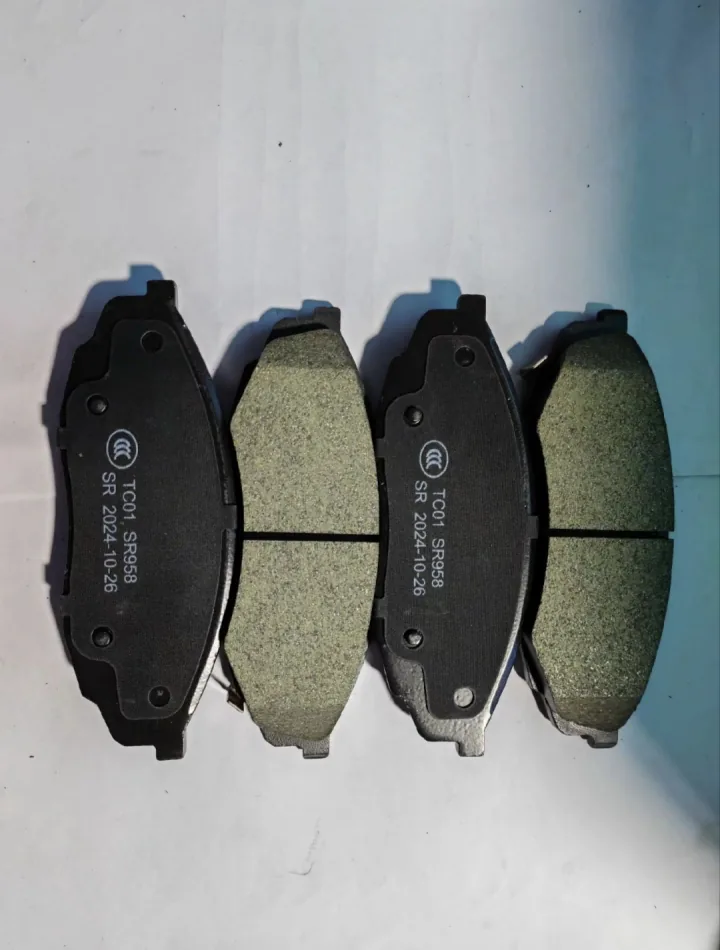
A returned brake pad carries a written record of how it failed. Reading it takes a few minutes and settles most claims before any commercial discussion begins.
What the wear pattern says
Even wear across both pads, worn to the backing plate. The pads did their job and reached end of life. If the mileage is low, the question is duty cycle — a taxi in hilly terrain will consume pads several times faster than a private car, and that is not a defect.
Inner pad worn, outer pad nearly new. The caliper did not slide. Guide pin seizure. Not a friction problem, and fitting new pads without freeing the caliper will reproduce it exactly.
Both pads on one corner worn fast, disc heat-discoloured. Piston not retracting, pad dragging continuously. Again a caliper problem.
Tapered wear — thicker at one end than the other. Usually the pad was not seating squarely: worn hardware, a bent backing plate, or debris in the caliper bracket.
Cracked or crumbling friction material. Severe overheating. Either the duty exceeded the product's capability or a caliper was dragging. Worth checking the disc, which will show matching heat damage.
Friction material separated from the backing plate. A genuine and serious manufacturing defect. This one is a real claim and should be escalated immediately, including checking whether other units from the same batch are in the field.
Glazed, glassy friction surface. Usually a bedding problem — the pads were not bedded and a hard stop deposited an uneven transfer layer, or the pads were used gently for so long that the surface polished.
The evidence a claim needs
Ask for these before making any commercial decision:
- Photographs of both pads from each affected corner, friction face and edge, with something for scale.
- Photograph of the disc from the same corner. The disc corroborates or contradicts the story the pad tells.
- Mileage and time in service.
- Vehicle type and duty — private car, taxi, delivery van, hill route.
- Whether hardware was replaced at fitting.
- Whether the pads were bedded in.
- Batch code from the backing plate, which is why the marking matters.
A workshop that cannot answer items five and six has usually identified the cause without realising it.
Distinguishing defect from fitting error, fairly
The temptation on both sides is to decide first and find evidence afterwards. A more durable approach is to classify against the physical evidence:
- Product defect — bond failure, material cracking without corresponding disc heat damage, dimensional error, wrong friction code against the approved sample. These are yours.
- Fitting or vehicle fault — uneven wear from caliper seizure, taper from worn hardware, glazing from no bedding. These are not, but the customer still has a problem.
- Duty mismatch — the product was correct as specified but the wrong formulation for the application. This one is shared: the specification conversation went wrong somewhere, and the honest resolution is usually a partial credit plus supplying the right product.
That third category is the one that damages relationships when handled as a flat rejection. A distributor who was sold a low-dust ceramic pad for a hill-route minibus fleet has a legitimate grievance even though the product is not defective.
Settlement structures that get agreed
Ranked by how readily they are accepted:
- Replacement product at no charge for a confirmed defect, plus freight.
- Credit against the next order — costs less in cash terms and keeps the relationship moving.
- Partial credit for duty mismatch or shared responsibility.
- Goodwill replacement for a first claim from a new distributor, even where the cause is fitting — it buys the relationship and it buys the conversation about fitting practice.
What rarely works is a flat rejection with a technical explanation and nothing else. Even when the analysis is correct, the distributor is left with an unhappy end customer and no path forward.
Preventing the next one
Most friction claims trace back to something absent at the point of fitting: hardware not replaced, pads not bedded, caliper not checked. Three low-cost measures address the majority:
- Include the hardware kit in the box, or sell it as a bundle by default.
- Supply a bedding instruction card, pictorial for markets where informal workshops do the fitting.
- Print a caliper check reminder on the packaging — one line asking the fitter to confirm the guide pins slide freely.
Each costs a fraction of one claim.