
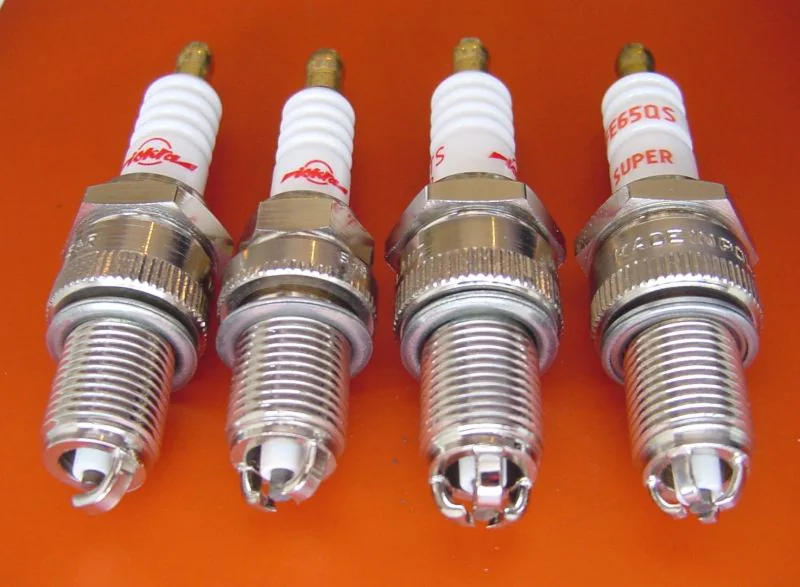
Heat range is the specification most often got wrong when a spark plug is substituted, and it is the one whose consequences are worst. A plug that is too hot does not simply run badly — it can hole a piston.
What heat range means
Heat range describes how quickly the plug conducts heat away from its firing tip into the cylinder head. It says nothing about the spark.
A hot plug has a long insulator nose, so heat takes a long path to reach the metal shell and the tip stays hotter. A cold plug has a short nose, sheds heat quickly and runs cooler.
The tip needs to sit in a fairly narrow window — hot enough to burn off deposits, cool enough to avoid becoming an ignition source itself. Roughly 500–850 °C is the commonly cited band.
Too cold: the tip stays below the self-cleaning temperature, carbon builds up, the plug fouls, misfires appear, and the engine runs rough. Annoying, but nothing is damaged.
Too hot: the tip glows and ignites the mixture before the spark does. This is pre-ignition, and it produces cylinder pressures the engine was not designed for. It destroys pistons, and it does so quickly under load.
The asymmetry matters commercially: if a substitution has to err, it should err cold.
Reading the numbers
There is no universal scale. Some manufacturers number so that a higher figure is colder; others do the opposite. A "7" from one range and a "7" from another are not comparable, and this is a routine source of wrong supply.
The only safe method is to work from a cross-reference for the specific engine, not from the number. When a customer asks for an equivalent to a plug you do not stock, confirm both the reference and the direction of that manufacturer's scale before quoting.
Electrode materials
| Material | Typical service life | Relative price | Notes |
|---|---|---|---|
| Copper core, nickel alloy tip | 20,000–30,000 km | 1× | Best conductivity, shortest life. Standard for older engines. |
| Platinum | 60,000–100,000 km | 2–3× | Harder tip, resists erosion. Single or double platinum. |
| Iridium | 100,000–160,000 km | 3–4× | Very fine centre electrode, lower voltage to fire, longest life. |
The mechanism behind the price difference is erosion. Every spark removes a tiny amount of metal, the gap widens, and the voltage needed to jump it rises until the coil can no longer supply it. Harder metals erode more slowly.
Iridium's fine centre electrode has a second benefit: a smaller electrode concentrates the electric field, so the plug fires at a lower voltage. That helps ignition reliability in engines with weak spark energy or high cylinder pressures.
Two cautions worth passing to customers. Fitting a long-life plug does not extend the service interval unless the engine manufacturer specifies it — other maintenance is tied to the same interval. And a fine-electrode plug in a very dirty-running engine may foul faster than a conventional one, because there is less thermal mass at the tip.
Gapping
Most plugs are supplied pre-gapped, and most of the time the gap is correct for the intended application. Two situations require checking:
The plug covers several applications with different specified gaps. The factory gap suits one of them.
The plug was dropped or knocked in transit. The ground electrode bends easily and a visibly bent electrode should be regapped or the plug discarded.
Adjusting a fine-wire iridium or platinum plug needs care: the precious metal tip is small and brittle, and levering against the centre electrode chips it. Only the ground electrode should be moved, using a tool that pushes on the ground strap alone.
Reading a used plug
The plug is the cheapest diagnostic instrument in the engine, and the appearance of a returned plug often explains a warranty claim:
- Light tan or grey deposits — correct heat range, healthy combustion.
- Dry black soot — running rich, or heat range too cold.
- Oily black — oil entering the chamber. Not a plug problem.
- White, blistered insulator, eroded electrode — running too hot. Heat range too hot, mixture too lean, or ignition timing advanced.
- Melted or broken electrode — pre-ignition or detonation. Investigate before supplying replacements, because replacements will fail the same way.
When a customer reports repeated plug failures, ask for photographs of the removed plugs before shipping a replacement batch. The deposits usually identify whether the plug or the engine is at fault, and that conversation is much easier before a second batch has failed.