
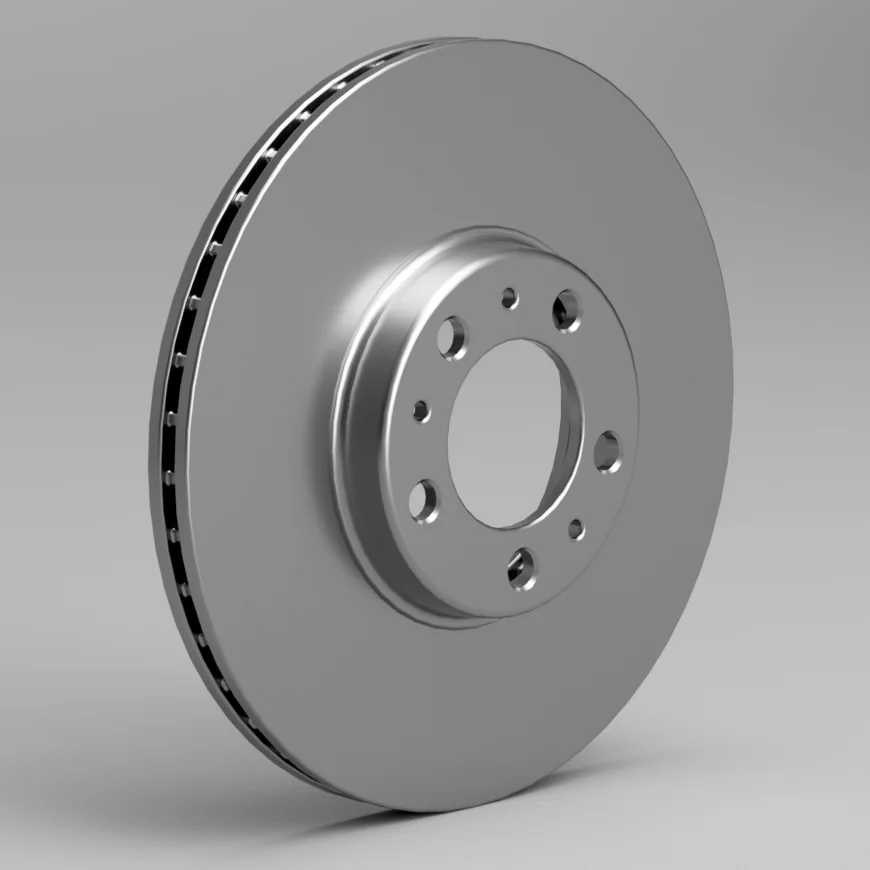
Two brake discs with the same part number and the same outer dimensions can differ in price by a factor of two. The difference is almost never visible in a photograph, and it sits in three places: the iron, the vanes and the machining tolerances.
The iron
Brake discs are grey cast iron, and the grade matters because it controls how the disc absorbs and sheds heat. Higher carbon content improves thermal conductivity and damping — the disc gets rid of heat faster and resonates less, which shows up as less noise and less cracking. Lower-carbon iron is cheaper to cast and machines more easily, and it is what a very low quotation usually contains.
The visible symptom of cheap iron is not immediate failure. It is heat checking: a network of fine surface cracks appearing after a few months of hard use, usually first on the outer edge. In a hot climate with long descents, that timeline shortens considerably.
What to ask a supplier for: the iron grade to a recognised national standard, and a hardness figure with the acceptable range. A supplier who can state neither is not controlling the casting.
Vane design
A ventilated disc has vanes between its two faces that pump air outward as the disc rotates. Three arrangements are common:
- Straight radial vanes. Cheapest to cast, works in either rotation direction so one part number covers both sides of the car. Cooling is the weakest of the three.
- Curved vanes. Better airflow, but directional — left and right discs are different parts, which doubles the SKUs and is a common cause of wrong-side fitment.
- Pillar or pin arrangement. Good cooling and non-directional, more expensive to cast.
Vane count and thickness also vary between a genuine casting and a copy that matched only the external dimensions. A disc that is dimensionally correct but has fewer, thinner vanes weighs less and costs less to ship — and runs hotter for the rest of its life.
The tolerances that decide whether a customer complains
Two measurements produce most brake judder complaints, and both are checked with a dial indicator in a couple of minutes.
Lateral runout — how much the disc face wobbles side to side through one rotation. Typical acceptable figures are around 0.05 mm measured on the vehicle, with the disc alone usually specified tighter. Excess runout makes the pads knock back in the caliper, and the driver reports a pedal that pulses.
Disc thickness variation (DTV) — the difference between the thickest and thinnest points around the disc. This is the one that actually causes judder. Tolerances are small, commonly in the region of 0.01–0.015 mm. It is worth noting how tight that is: a fingerprint is thicker.
Runout and DTV are related. A disc mounted with excess runout wears unevenly in service and develops DTV over a few thousand kilometres, so a disc that measured fine at fitting can judder later. That is why the hub face must be clean and free of rust when the disc is fitted, and why hub runout should be checked before blaming the disc.
Minimum thickness, and why machining is usually false economy
Every disc carries a minimum thickness cast or stamped into it. Below that figure the disc has insufficient mass to absorb heat and insufficient material to resist cracking.
Machining a worn disc removes material to restore a flat surface. It works, but it takes the disc closer to minimum thickness, which reduces its heat capacity for the remainder of its life. Given that discs are among the cheaper mechanical parts, the labour cost of machining plus the shortened life usually exceeds the saving. For aftermarket export, replacement is the sensible recommendation, and machining is worth mentioning only where a disc is expensive or hard to source.
Incoming inspection worth doing
- Thickness at eight points around the disc with a micrometer. Calculates DTV directly.
- Hardness at several points on the friction face. Wide variation across one disc indicates inconsistent casting or cooling.
- Weight against a reference sample. A disc noticeably lighter than the reference has less iron somewhere — usually in the vanes.
- Visual check of the casting for porosity or inclusions on the machined face.
These four checks on a small sample from each batch catch most of what separates a good disc from a cheap one, and none of them needs specialised equipment.