
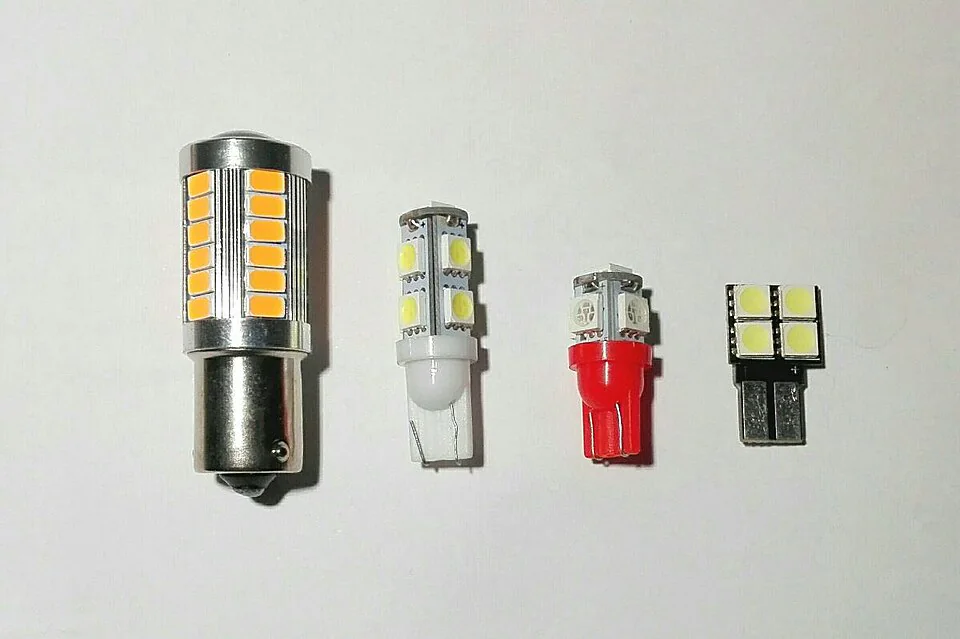
An LED retrofit bulb that produces three times the lumens of the halogen it replaces can still light the road worse — and blind everyone coming the other way. The reason is that a headlight is an optical system, and the bulb is only one part of it.
The reflector was designed around a filament
A halogen bulb produces light from a small filament in a precisely defined position inside the glass. The reflector or projector lens is shaped around that exact position, and every ray it collects is aimed deliberately — down onto the road, with a sharp horizontal cut-off so light does not go above it into oncoming eyes.
An LED retrofit puts flat emitter chips where the filament was. Two things change:
Light source geometry. A filament radiates in essentially all directions from a small volume. LED chips radiate from flat surfaces, usually two, facing sideways. If the chip plane is not oriented exactly as the reflector expects, light leaves at angles the optics were never designed to handle.
Light source position. The emitting surface must sit at the same distance from the bulb base as the original filament. A few millimetres of error moves the beam's focus, blurring the cut-off line.
Get either wrong and light scatters. The road ahead may actually be darker because the light that should have been aimed at it is now spread into the sky, into the hedge and into the windscreen of the oncoming car.
The cut-off line tells you everything
Project the beam onto a flat wall a few metres away. A correct low beam produces a distinct horizontal cut-off, usually with a step or angled section on one side to light the kerb.
Diagnostic patterns:
- Sharp cut-off, even fill below it — the retrofit is optically correct for that housing.
- Fuzzy cut-off with a glow above the line — emitter position is wrong. This is the batch that generates glare complaints.
- Bright hotspot with dark areas — chip orientation is wrong relative to the reflector.
- No cut-off at all — the bulb is being used in a housing designed for a different source type, and no adjustment will fix it.
This test takes two minutes and should be run on a sample from every batch, in an actual headlight housing rather than on a bench.
Colour temperature: what customers ask for versus what works
Buyers request high colour temperatures because they look modern. The trade-off is worth stating plainly to customers:
- 4300–5000 K — closest to daylight, best contrast on a dry road, best in rain and fog.
- 6000–6500 K — noticeably blue-white, the most requested, slightly worse in rain because short wavelengths scatter more in water droplets.
- 8000 K and above — strongly blue, measurably less usable light on the road, and illegal for road use in many markets.
Higher colour temperature does not mean brighter. It often means less usable light, because output is shifted toward wavelengths the eye is less sensitive to.
Heat management decides the life
An LED emitter's life collapses with junction temperature. A halogen bulb radiates its heat; an LED must conduct it away through the base into a heatsink or fan.
Two failure modes to watch for in the field:
Gradual dimming over months. The heatsink is undersized or the thermal path is poor. Output falls slowly enough that the customer blames something else.
Sudden failure in hot climates. A bulb specified for a temperate market fails quickly in a hot one, particularly in a sealed housing with poor ventilation. If the destination market is hot, this is a specification question and not an afterthought.
Fan-cooled designs handle heat better but add a moving part and a noise the customer can sometimes hear at idle. Passive designs are more reliable but need a housing with enough space behind the bulb — worth checking against the vehicle before committing to a design.
Regulatory reality
In many markets an LED bulb fitted into a housing type-approved for halogen is not legal for road use, regardless of how good the beam pattern is. This varies by market and enforcement varies further, but it is a real commercial risk that should be disclosed to the buyer rather than discovered by them. The safest position is to be explicit about the intended market and about what approval the product does and does not carry.