
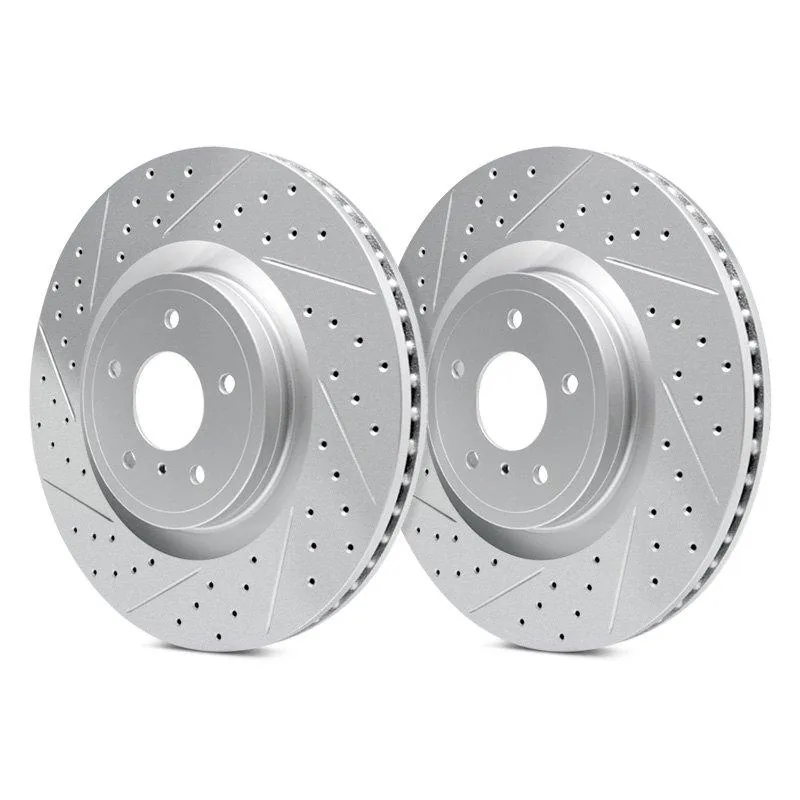
Cross-drilled discs sell because they look like motorsport equipment. The engineering argument behind the holes was largely solved fifty years ago by better friction materials, and what remains is mostly appearance plus a crack risk.
What the holes were originally for
Early friction materials outgassed heavily when hot. The gas formed a layer between pad and disc that reduced friction, and drilling gave it somewhere to escape. Modern friction formulations outgas far less, which removes most of the original justification.
The second argument is water clearance in wet conditions. This one is real but small — the first light brake application clears the disc face regardless, and slots do this job better than holes anyway.
The third argument, weight reduction, is marginal: a drilled disc is a few percent lighter than the same casting undrilled, and the reduction comes from exactly the material that was carrying heat.
The crack risk
This is the part that matters commercially. Every hole is a stress concentration in a component that goes through severe thermal cycling. Cracks initiate at hole edges and propagate between holes.
Two things determine how bad this is:
Cast holes versus machined holes. A disc cast with the holes in place has continuous grain structure around each hole and much better crack resistance. A plain disc drilled afterwards has cut grain and sharp edges at every hole, and it is markedly more crack-prone. The cheaper product is almost always the drilled-afterwards one, and the difference is visible on close inspection — cast holes have a slightly radiused, textured edge.
Chamfering. Machined holes should be chamfered on both faces to remove the sharp edge. Unchamfered holes are the worst case, and they are also the cheapest to produce.
For a customer in a hot climate doing long descents, a cheaply drilled disc will craze and eventually crack. That is a warranty conversation worth avoiding by not selling the product into that use case.
Slots
Slotting is the more defensible option. A slot sweeps the pad face, removing the glazed surface layer and any debris, which helps maintain friction in repeated hard use. Because slots are shallow and continuous rather than through-holes, they weaken the disc far less.
The trade-off is pad wear. Slots act on the pad every revolution, and pads on slotted discs wear noticeably faster. Some customers also find them noisier.
What to recommend to whom
- Ordinary road use, any climate — plain vented disc. Best heat capacity for the money, longest life, no crack risk, quietest.
- Repeated hard use — mountain roads, towing, fast road — slotted. The pad-cleaning effect is genuine under these conditions.
- Appearance-driven customers — drilled, but only cast-and-chamfered, and with the durability trade-off explained.
- Heavy vehicles, commercial use, hot climates — plain, without exception. Thermal mass is what matters and holes remove it.
Selling it honestly
Customers ask for drilled discs by name, and refusing the sale is not the answer. What works is offering both with a straight explanation: the drilled disc looks the part and is fine for normal road use if it is a quality casting; the plain disc will handle heat better and last longer. Most customers who understand the trade-off still buy what they came for, and the ones who change their mind do not come back with a cracked disc.
What is worth refusing is drilling a plain disc to order. It converts a good component into a compromised one, and the resulting cracks come back as a claim against you.